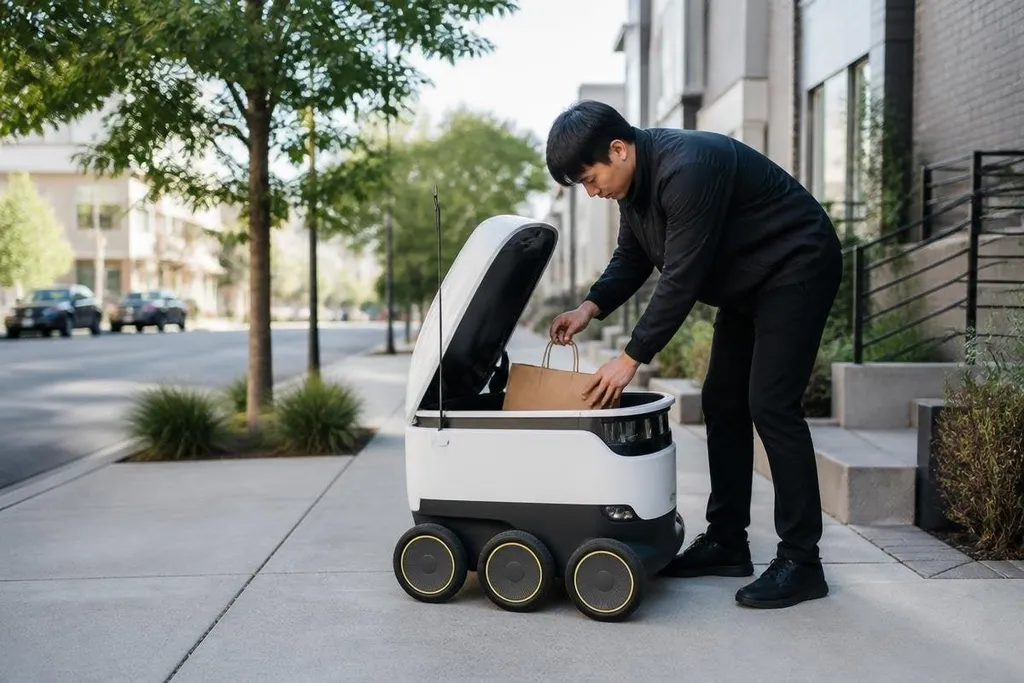
A delivery robot may carry groceries, meals, or parcels for the final part of a route. The larger business opportunity sits around that trip: fleet software, remote support, charging, maintenance, and access to useful curb space.
If you’re assessing this market, the first question is not how many robots a company can build. It’s who pays for the work around each robot and what service keeps paying after the pilot ends.
- Delivery fees can pay for each completed trip.
- Fleet services can handle dispatch, monitoring, and maintenance.
- Local access can give operators approved places to charge, load, and wait.
Delivery is the starting service
A robot can lower the cost of a short delivery when a human courier would spend much of the trip walking, waiting, or driving a small vehicle. That only works when the route is predictable and the robot can reach the customer without a person taking over every few minutes.
The buyer may be a restaurant, grocery company, parcel carrier, property manager, or delivery platform. Each buyer has a different need. A restaurant may care about hot food arriving within a set time, while a property manager may care more about moving items between buildings on one site.
That difference creates room for several service models. An operator can charge per delivery, rent robots by the month, or sell a managed route with staff, charging, and support included.
The contract needs to state who handles failed deliveries, blocked paths, damaged goods, and customer handoffs.
The service work around each robot
The robot is the visible part of the system. A working route also needs dispatch software, mapping, battery charging, cleaning, repairs, customer messages, and a person who can take control when the robot stops.
Remote support may become a business of its own. One operator could watch several robots when routes run normally, then step in when a door, road crossing, or parked vehicle blocks progress. The exact staffing need depends on the route and the robot, so a buyer should ask for logs from live operations instead of accepting a staffing estimate on paper.
Maintenance gives another company a place to earn revenue. Last-mile robots work near rain, dust, curbs, ramps, and other street hazards. A service provider could stock replacement wheels, cameras, covers, and charging parts near the routes it supports. The open issue is demand: a small fleet may not create enough repair work to support a local team.
Once a fleet moves beyond a trial, the next question is who pays for access, parking, and recovery. Reports on last-mile robotics business models can help you compare those costs with the routes and service work behind them.
Access can become its own market
Every delivery robot needs somewhere to load, wait, charge, and hand over goods. Those points may sit on private land, beside a store, inside an apartment complex, or near a public street. Property owners can sell managed access to those places, with rules for hours, safety checks, and service vehicles.
That model needs care. A charging point beside a busy entrance may slow people down, block a wheelchair route, or create a safety problem. The best site is not always the cheapest empty space. It has to fit the robot’s route, the building’s layout, and local access rules.
Data can support another service. Fleet operators may sell reports on delivery times, blocked paths, failed handoffs, and demand by location. Those reports help a retailer decide where a robot route makes sense, but the data must be collected with clear permission and stored safely.
Where the money can disappear
Last-mile robots still depend on streets, buildings, customers, and local rules. A route can look efficient on a map and fail at a locked gate. A robot that needs frequent remote help may shift labor costs rather than remove them.
I’d skip any plan that counts robot deliveries but leaves charging, repairs, failed trips, and remote support out of the cost model.
A business plan should answer these points before a paid trial:
- Name the payer: write down who signs the contract and what event triggers payment.
- Map the handoff: record where the robot gives goods to the customer or staff member.
- Count human work: include monitoring, loading, cleaning, recovery, and customer help.
- Check the route: test gates, crossings, ramps, weather exposure, and charging locations.
- Set failure rules: decide who pays when a delivery runs late, breaks, or returns.
The strongest opportunity may sit with companies that make the route dependable, not with the company selling the robot alone. Until operators publish route costs, human support hours, and failure rates, the safer business is the one that earns from a defined service with clear limits.